
After a long stretch of work, it’s a bit of an extended lunch at the moment as enjoying a holiday in Türkiye’s so expect some sun-kissed reviews. The apartment we’re in seems to be playing a long with the limited space for games – this is the table!

There’s always the quandary of which games to pack that can balance the need for solo gaming and that can be played with various family members.
How it plays
With Death Valley you begin by taking the 18 cards and shuffling them into a draw pile, turning over the top one so it is visible. The context of the game is that you’re on a journey through death valley and the cards represent that journey. Each card contains a number of stars (used for final scoring), an ability that will augment scoring in some way, and one of four types of hazard. You need to pay attention to hazards as if you end up with three of the same type In front of you, you bust which has serious consequences for your journey.
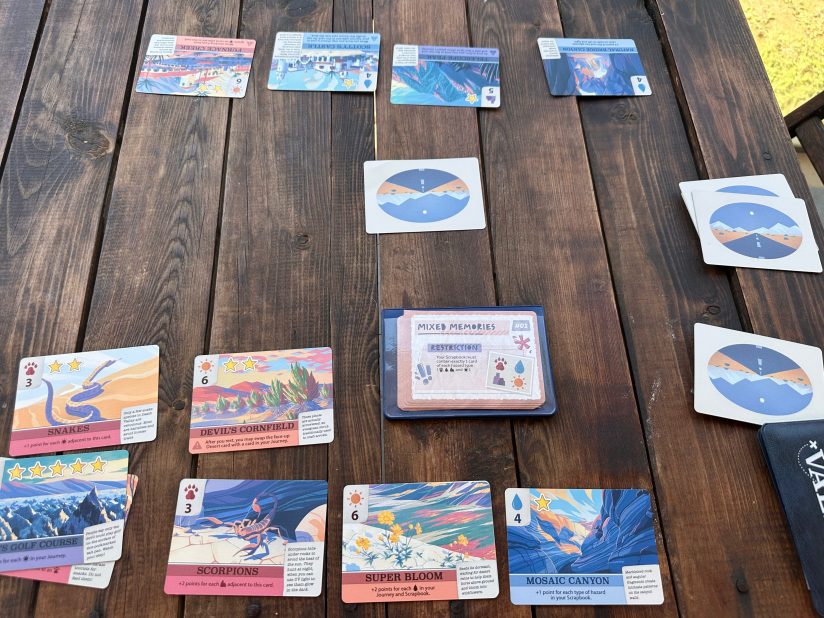
On your turn you have the option to do one of three things. 1. Take either the visible card or the top card of the draw deck and add it to your journey.2. Force the bot to take the visible card into their journey. 3. Rest and move a card from your journey to your scrapbook, a second row which stops you losing cards if you bust, and that can benefit scoring.
On its turn the bot can perform all the actions except rest. Game plays until there is only card left in the draw pile. You then score, the one with the most points wins.
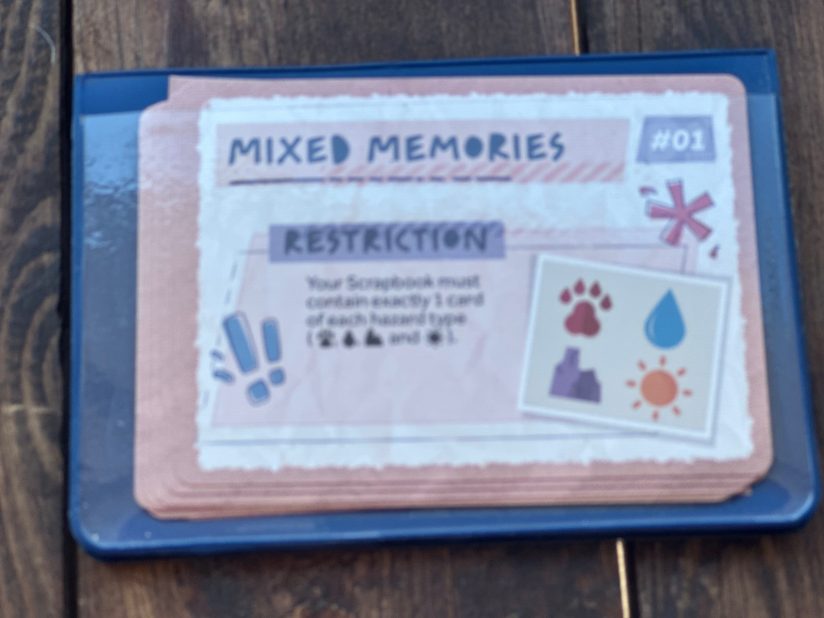
Death Valley: Solo Challenges is a separate wallet of 18 cards consisting of unique challenge cards, each one altering the way you approach a game. While each doesn’t alter game play – it’s still a push-your-luck, tableau-building game, it does give solo players a set of fresh conditions for winning. For example in challenge 1 you need to beat the bot on points but also have all the different hazards in your scrapbook.
What these challenges bring is variety. Every play shifts slightly depending on the restrictions or modifiers you’re working under. It keeps the game lively and adds an extra tension into your luck pushing.
Good for lunch?
Absolutely. It’s light, quick, and pocket-sized, so you can play it on a holiday table and still have space for some mezes. Death Valley is one of my favourite wallet games as you can pretty much teach it to anyone. Despite looking small it hits the sweet spot of tension and simplicity though if truth be told while the solo bot works it doesn’t always present an exciting challenge. This is where the solo challenges really changes things. Sure, the bot is still acting in the same way but the challenges ensure variability with their alternate goals and restrictions. That said, it isn’t endless, with only 18 cards, you’ll eventually go through them all, and as such freshness and replayability might fade over time, and of course you need to be au fait with the base game before you jump in.
 Lunch time solo